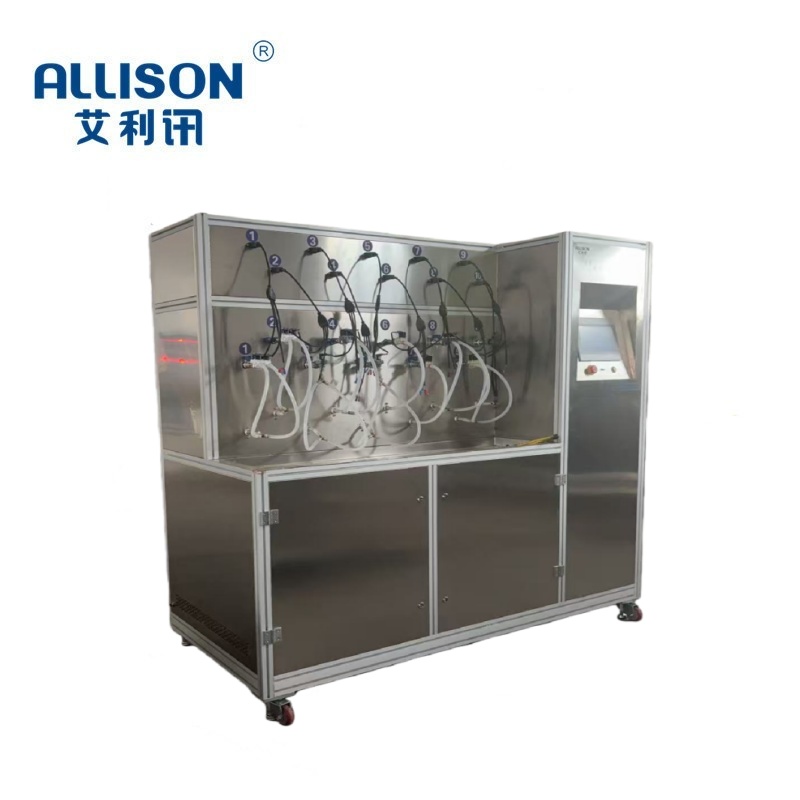
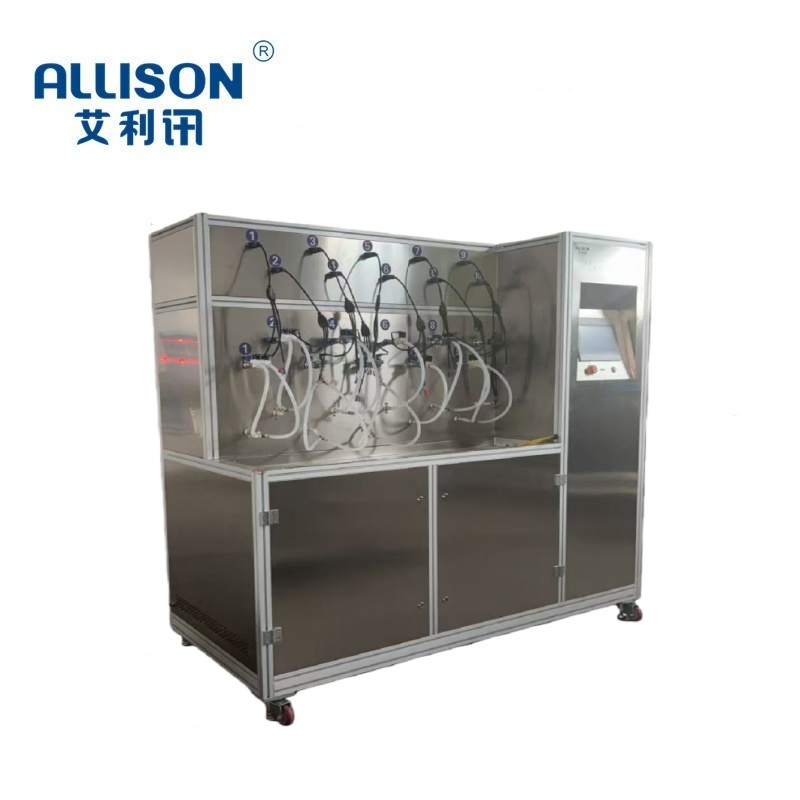
The testing device consists of a precision loading mechanism, a high-precision sensing module, a controllable DC power supply, a data acquisition system, an industrial control host, and a dedicated testing fixture. The overall equipment structure has strong rigidity, no deformation, and no looseness. The surface roughness Ra of the testing workbench is ≤ 0.8 μ m, which meets the accuracy requirements of the suction cup matching working surface in JB/T 10577-2006 standard, ensuring the accuracy of the testing fitting.
The power module can achieve 0~30A DC stable output and 0~5kV withstand voltage testing, with high precision in voltage and current regulation. It can simulate various working conditions such as suction cup rating, overload, undervoltage, etc; The force sensor, displacement sensor, and temperature sensor all adopt industrial high-precision level, with fast response speed and strong anti-interference ability, suitable for complex testing environments in workshops. The overall protection level of the equipment complies with the IEC 60529 standard and can effectively prevent dust, moisture, and electromagnetic interference. The core structure of the electromagnetic suction cup is mainly composed of two parts: the electromagnet and the suction end. The overall structure is simple and stable, suitable for clamping use scenarios of automotive parts and precision components of aerospace satellites. The adsorption end adopts high-quality soft magnetic materials, which have excellent magnetic conductivity, low residual magnetism, and fast magnetic response, effectively reducing the risk of residual adsorption during workpiece unloading and ensuring the surface and dimensional accuracy of precision components.
The electromagnet is equipped with two independent coils, one main and one backup, with redundant design greatly improving the reliability of equipment operation. When the equipment is working, direct current is applied to any group of coils, and a stable magnetic field is formed based on the physical principle of "electric magnetic generation". A constant adsorption force is generated between the electromagnet and the adsorption end, achieving reliable clamping and fixation of the workpiece.





 Online
 Tel
Tel Contact
 Home
Home