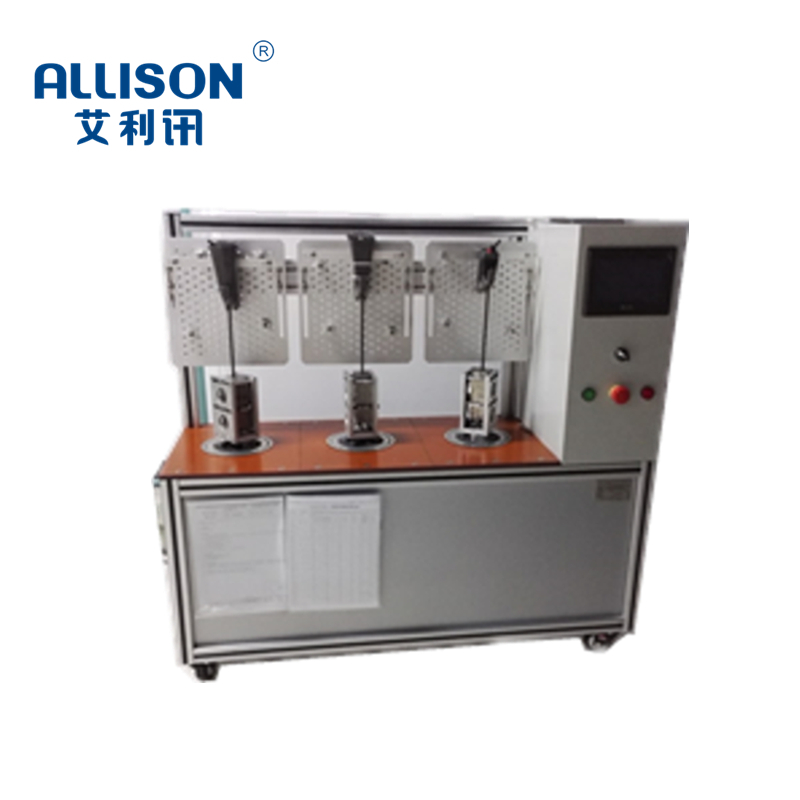
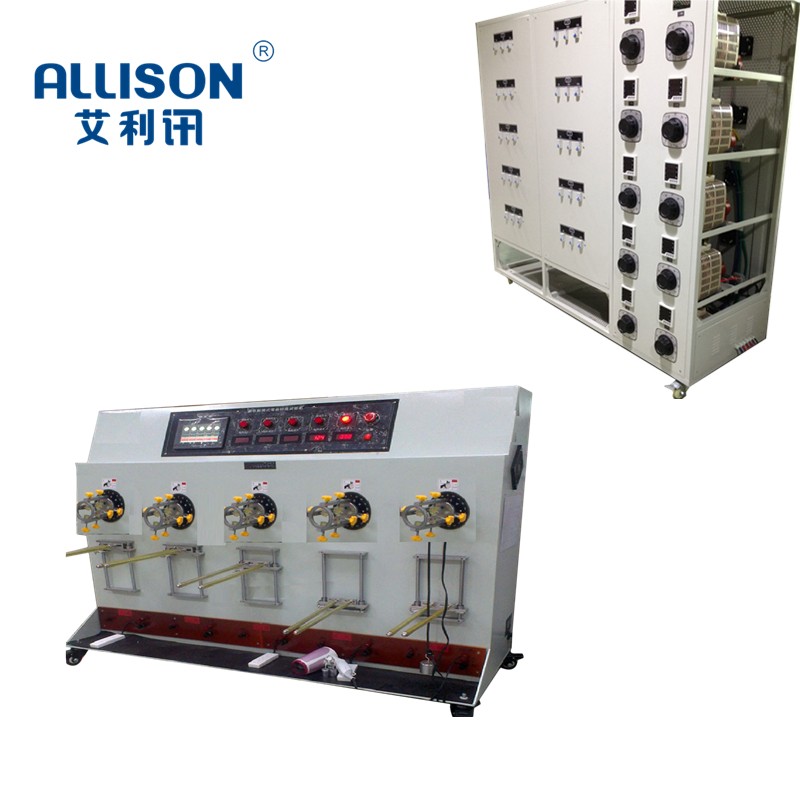
The wire torsion testing machine is designed to test the torsion strength of various metal wires and the number of torsion resistance times of the paint film of the enameled wire. The test method is to clamp the two ends of the sample and one end is fixed, and the other end is continuously twisted back and forth until the sample is twisted or the paint film of the enameled wire falls off, exposing the conductor, and recording the number of torsion resistance. The wire winding + torsion testing machine complies with both the GB/T4909.4-2009 standard and the GB/T4909.7-2009 standard.
Technical parameter:
1. Detection method: current, voltage, on-off times
The main function:
Unidirectional torsion: The sample rotates 360 degrees evenly in one direction around its axis as one twist to the specified number of times or the sample breaks
Two-way twisting: The sample rotates 360 degrees in one direction evenly around its axis as one twist to the specified number of times, then rotates the same number of times in the opposite direction or the sample breaks.
The main purpose:
The metal wire torsion testing machine is suitable for measuring the diameter (or characteristic size) of the metal wire to withstand plastic deformation in one-way or two-way torsion and to display the surface and internal defects of the wire.
Sample standard:
The test piece should be as straight as possible and straightened if necessary, but the surface should not be damaged or twisted. In order to make the test piece straight during the test, some form of tension should be applied. This tension should not be greater than 2% of the corresponding force value of the nominal tensile strength of the test wire. The axial force is increased by weights. force.
The main technical parameters
1. Horsepower: DC/1HP
2. Fixture action: chuck type
3. Fixture spacing: 0~500m
4. Speed: 6~60 r/min can be set arbitrarily
5. Number of rotations: 0~999999 can be set arbitrarily
6. Applied load: 5Kg, 10Kg, 15Kg
7. Equipment size 1300×550×1400 Unit: MM








 Online
 Tel
Tel Contact
 Home
Home