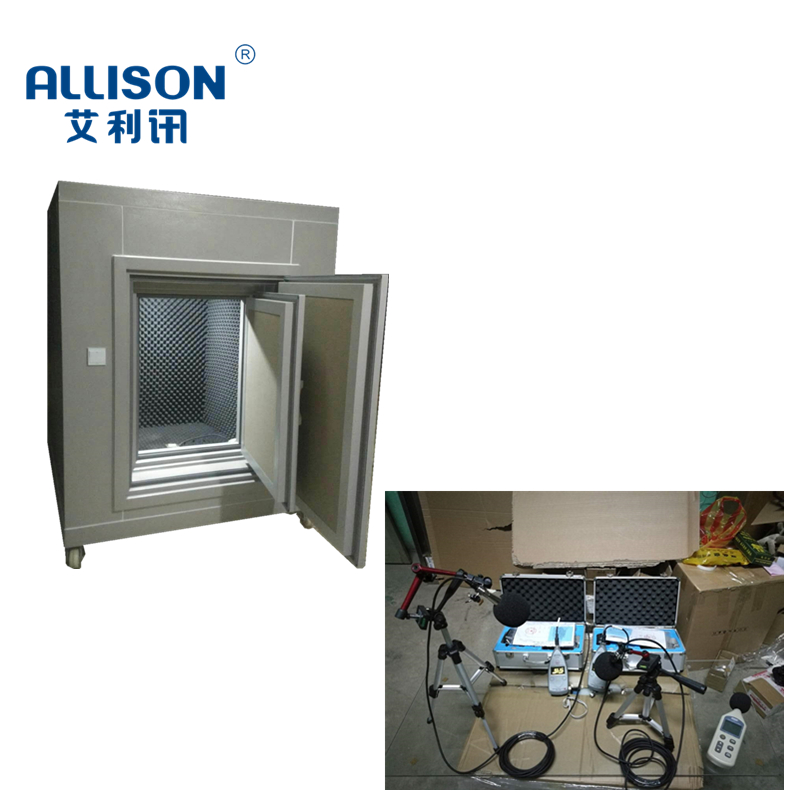
Soundproof room, silent box, anechoic test room, silent test box, soundproof box, anechoic room, anechoic room, shielded room, shielded network room, shielded laboratory, shielded test room. Used for mute testing of various electronic mechanical components, etc. The sound insulation component is composed of a number of single-layer components, which have the characteristics of a single-layer component in the sound insulation mechanism and the comprehensive characteristics of various single-layer components. A member with an air layer between two unconnected single-layer members. The air layer plays a cushioning elastic role, but can also cause resonance of the two layers of components. Therefore, the sound insulation of a double-layer member is not a superposition of the sound insulation of the two-layer member. If the air layer is filled with porous sound-absorbing material, resonance can be reduced and the sound insulation of the component can be improved. The increase in sound insulation due to the air layer is proportional to the thickness of the air layer within a certain range. Generally, a double-layer wall can increase the sound insulation by about 5 decibels than a single-layer wall of the same weight. The structure of doors and windows is light and has gaps, so the sound insulation ability is not as good as that of walls. For doors with high sound insulation requirements (sound insulation of 30 to 50 decibels), a simple reinforced concrete door leaf can be used. But it is usually a door leaf with a composite structure. The impedance change of this structure can improve the sound insulation capability. Sealing the gap is also an important measure to ensure the sound insulation of doors and windows. It is better to use industrial felt as a sealing material than latex strip, especially for high frequency noise. For windows with high sound insulation requirements, the window glass must have sufficient thickness (6-10 mm) and at least two layers. The two layers of glass should not be parallel to avoid resonance and reduce the sound insulation effect. The gaps between glass and window frames, window frames and walls should be sealed tightly. On the periphery between the two glass windows, strong sound-absorbing materials should be arranged to increase the sound insulation.











 Online
 Tel
Tel Contact
 Home
Home