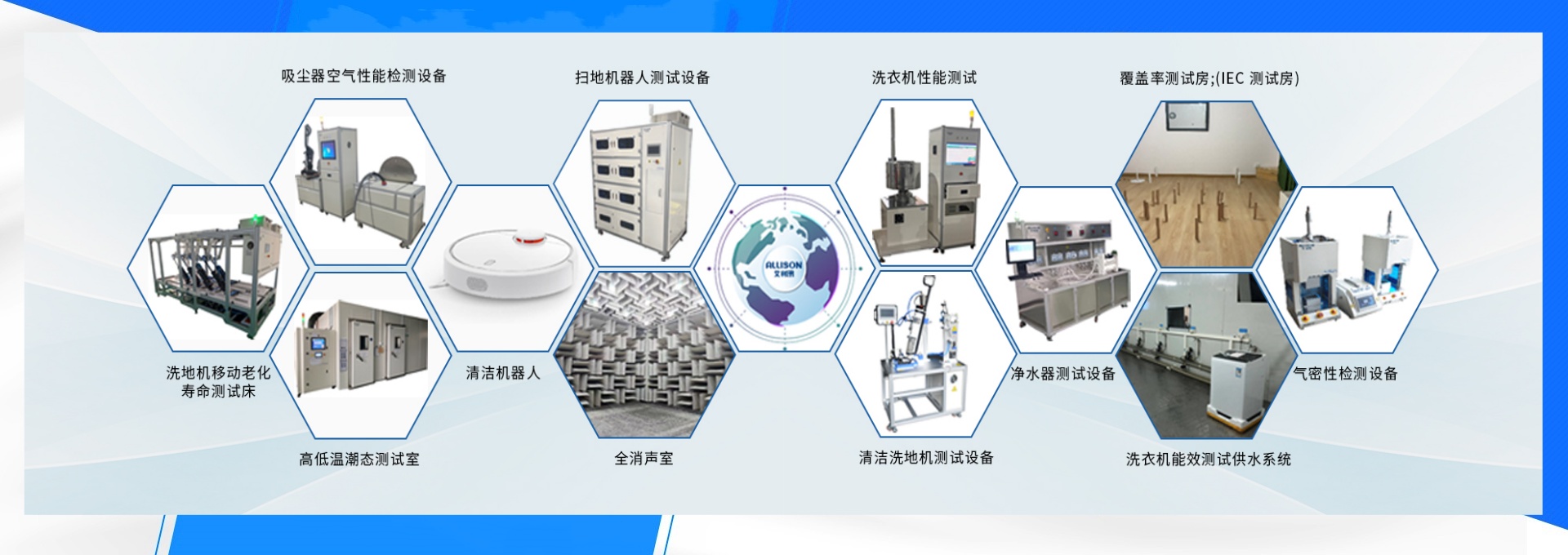
The robot vacuum cleaner drive wheel lifespan test bench is designed for simulating real-world usage conditions to test the aging
and lifespan of robot vacuum cleaner drive wheels. It is controlled by a PLC and configured through a 7-inch touch screen. A DC power
supply continuously powers the robot vacuum cleaner, and a magnetic powder brake is used to test the durability and lifespan of the drive wheel.
The test simulates real-world usage conditions based on the number of tests and duration. Relevant test data can be exported via USB. It is versatile, easy to operate, convenient to control, and has a low failure rate.
1. Durability test of drive wheel assembly
- Continuous rotation durability: Set total mileage (such as 500km~1000km) or time
- Intermittent start-stop durability: periodic forward rotation, reverse rotation, start-stop, simulating actual use
- Inspection items: tire wear, wheel hub cracking, degumming, deformation, and skidding
2. Obstacle surmounting and impact durability test
- Climbing over obstacles of a fixed height (such as thresholds/steps of 10mm to 20mm)
- Cyclic drop impact, repeated rolling impact
- Inspection: fracture of wheel arm, deformation of bracket, looseness of bearing, and loosening of fasteners
3. Load climbing performance and durability
- Set a gradient (8°~15°) for continuous climbing operation
- Detection: motor current, torque decay, tire slip, temperature rise, transmission failure
4. Drive motor performance test
- Operating current, locked-rotor current, operating temperature rise
- Motor insulation, commutator/carbon brush wear, encoder signal stability
- After prolonged operation, there may be a decrease in rotational speed, abnormal noise, and seizure
5. Durability of transmission system
- Fatigue test of gearbox/reducer
- Gear wear, broken teeth, lubrication failure, abnormal noise, increased clearance
- Belt/drive belt stretching, slipping, or breaking
6. Tire wear resistance and friction performance
- Tire wear, thickness reduction, and surface peeling
- Changes in grip and slip ratio on dry and wet surfaces
- Material aging, hardening, and cracking
7. Vibration and noise testing
- Operational vibration value, structural resonance
- Variation of noise level over the life cycle
8. Environmental adaptability enhancement test (optional)
- Durability under high and low temperature cycling
- Operating in a dusty environment (dust-proof, anti-clogging)
- Insulation and corrosion under hot and humid conditions





 Online
 Tel
Tel Contact
 Home
Home