Standard test conditions (fully automatic operating conditions)
1. Water quality conditions (hard water simulation)
- Total hardness: 250±20 mg/L (CaCO₃), alkalinity: 140±20 mg/L
- pH: 7.0~7.5, conductivity: 1000±100 μS/cm, turbidity ≤1 NTU
2. Operating conditions (PLC fully automatic control)
- Flow rate: 2 L/min, single water intake volume: 5 L
- Heating temperature: 80±2℃, constant temperature maintenance: 8 hours per session
- Circulation mode: water intake → heating to maintain constant temperature → water drainage, lasting for 16 hours daily, for 21 consecutive days
3. Environmental conditions
- Inlet water temperature: 25±1℃, ambient temperature: 25±5℃
II. Core Test Content (6 Major Items)
1. Scale inhibition rate test (core indicator)
- Method: Calcium carbonate deposition comparison method (blank group vs experimental group)
- Determination: Scale inhibition rate ≥85% (GB/T 16632); ≥ nominal value (GB/T 30306)
- Detection: scaling amount of heating tube, calcium ion concentration, weight difference of scale
2. Release performance (dissolution rate) of Silicophosphate Crystal
- Monitoring: Effluent phosphate concentration (2~3 mg/L), TDS value changes
- Determination: Stable dissolution, no burst release, no discontinuous release, meeting the safety limits for drinking water
3. Dynamic cycle durability life
- Continuous flow: ≥500h, thermal cycling: 25℃↔80℃
- Assessment: structural integrity of filter element, loss rate of silicate phosphate crystal, and scale inhibition performance attenuation (≤10%)
4. Observation of scaling morphology on heating tubes
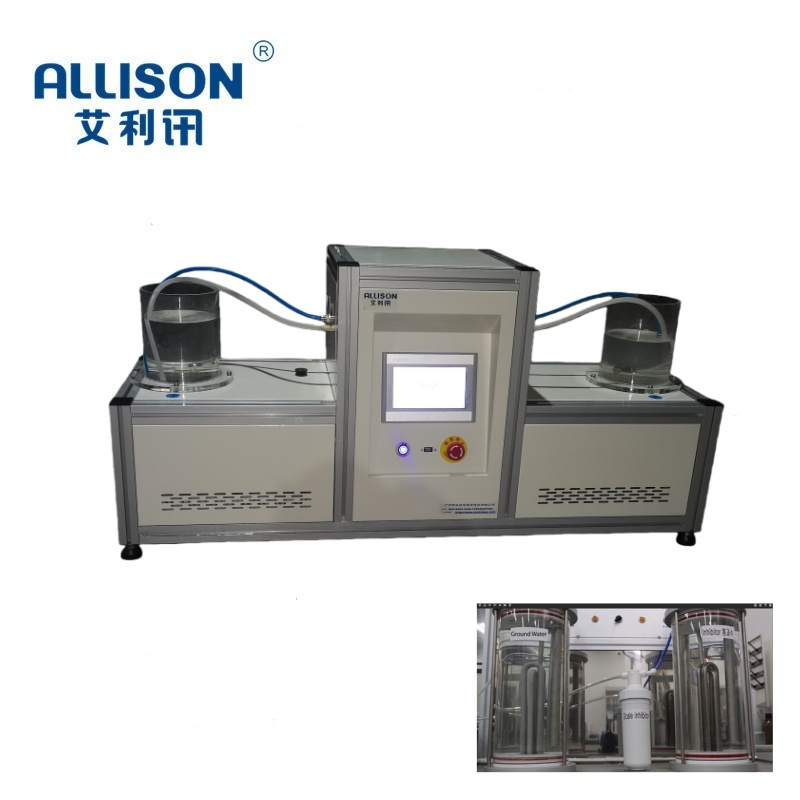
- Visualization: Observe the amount, thickness, and compactness of scale deposition through a high-temperature resistant glass window
- Comparison: Blank group (severe scaling) vs Experimental group (mild/no scaling)
5. Comprehensive monitoring of water quality parameters
- Real-time collection: pH, hardness, conductivity, turbidity, temperature, flow rate
- Record: ion concentration fluctuation, stability of scale inhibition components
6. Failure determination
- Excessive scaling, abnormal leaching, damaged filter element, sudden performance decline, and off-flavor in effluent
III. Functions of fully automatic equipment
- PLC program control, touch screen parameter setting, automatic water inlet/heating/drainage/circulation
- Automatic data collection, curve generation, automatic calculation of scale inhibition rate, and report export
- Multi-station parallel operation, precise control with constant temperature and current





 Online
 Tel
Tel Contact
 Home
Home