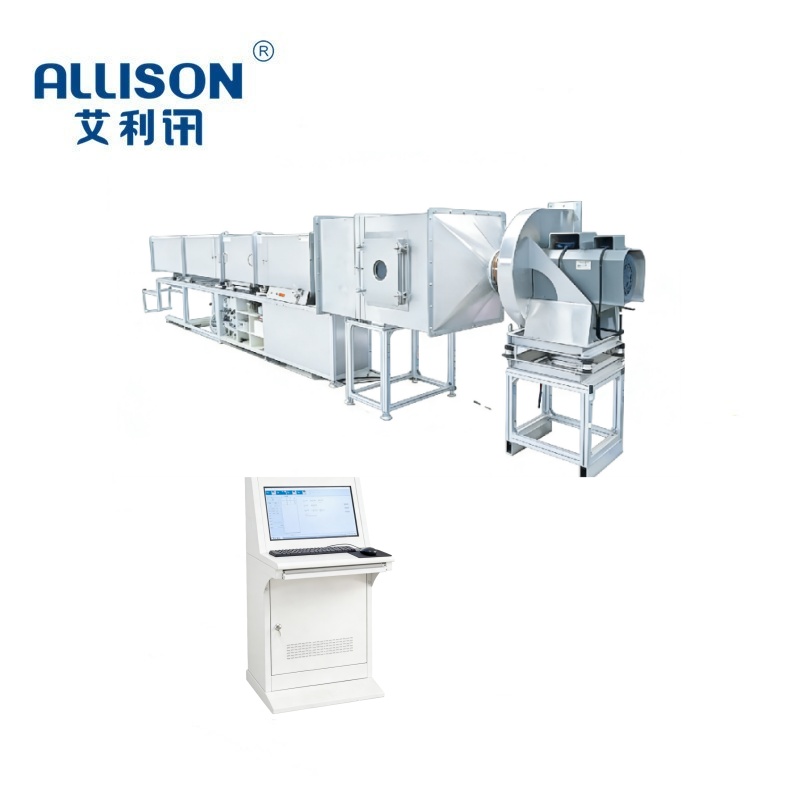
This testing system is specifically designed for radiator performance testing. GB/T 1236-2017 Standardized Duct Performance Testing for Industrial Fans AMCA210-07 The entire control and testing system adopts an automatic control method, meeting the needs of various radiator and fan performance testing. The automatic control and measurement methods of this testing system are designed using a computer-based centralized distributed measurement and control system. The lower-level control computers composed of data systems collect and display data, while the upper-level master control computer analyzes and processes the data collected by the lower-level control computers, and issues setpoint commands and data acquisition commands to the lower-level control computers to complete the work of the entire system. The measurement principle of this testing system is the obstruction-based flow measurement principle, using a standard long-diameter low-speed nozzle as an obstruction. The air flow through the nozzle is measured by measuring the static pressure difference at both ends of the standard nozzle
Air volume and pressure measuring devices (used in home appliances/automotive fields such as fans, range hoods, air conditioners, air purifiers, and air ducts) have the following core testing content and basis standards, directly covering the full dimensions of performance, accuracy, sealing, and durability:
1. Core testing content of air volume measuring device
1. Air volume indication error (core accuracy)
Test content: On a standard wind tunnel/air volume platform, compare the measured air volume of the device with the standard value, and calculate the relative error, linear error, and repeatability error
Coverage: rated air volume, minimum/maximum air volume, accuracy at different air speed ranges
2. Wind speed uniformity and stability
Test content: Inspect the uniformity of wind speed distribution in the probe/sensor area; measure the fluctuation value of air volume during long-term operation
3. Response time
Test content: Under step wind speed, the rise time and response lag time for the device to reach stable readings
4. Range and resolution
Test content: minimum measurable air volume, maximum range; air volume resolution, display accuracy
5. Environmental adaptability
Test content: drift of air volume measurement accuracy under high and low temperature, damp heat, and dusty environments
6. Tightness (duct type)
Test content: Air leakage amount of device air duct and interface (air leakage rate ≤ specified value)
II. Core testing content of pressure measuring device
1. Pressure indication error (static pressure/dynamic pressure/total pressure)
Test content: Compare the measured pressure with the standard pressure source, and calculate the static pressure error, dynamic pressure error, return error, and repeatability
Coverage: full range of positive pressure, negative pressure, micro pressure (Pa level), and high pressure segment
2. Pressure sensitivity and linearity
Test content: Change in output signal corresponding to change in unit pressure; linearity error of pressure-output curve
3. Overvoltage protection performance
Test content: After an over-range pressure impact, the device's accuracy recovery, whether it is damaged, and its pressure resistance limit
4. Temperature compensation error
Test content: pressure zero drift and sensitivity drift at different temperatures
5. Long-term stability (durability)
Test content: Pressure accuracy decay under continuous loading/alternating pressure for 72h/1000h
III. Integrated Test of Air Volume and Pressure (Overall Machine)
1. Wind-pressure characteristic curve (P-Q curve)
Test content: Changes in air volume under different static pressures; drawing an air volume-pressure relationship curve
2. Resistance characteristic test
Test content: device's own air duct resistance, pressure loss coefficient
3. Dynamic response (alternating operating conditions)
Test content: When the air volume/pressure is alternating, the device synchronizes and tracks the accuracy and phase difference
IV. Commonly used implementation standards (including standard numbers)
1. GB/T 1236–2022 Ventilators - Aerodynamic Performance Test Methods (Air Volume/Pressure Core National Standard)
2. GB/T 17774–2022 Industrial Fans - Performance Testing
3. GB/T 19411–2023 Range hoods for household and similar purposes - Test methods for air performance (specific for air volume/static pressure of range hoods)
4. JJG 620–2018 Verification Regulation for Wind Tunnel Airflow Meters (Metrological Calibration)
5. JJG 875–2019 Verification Regulation for Digital Pressure Gauges (Pressure Accuracy Calibration)
6. ISO 5801:2017 Industrial fans - Performance testing





 Online
 Tel
Tel Contact
 Home
Home