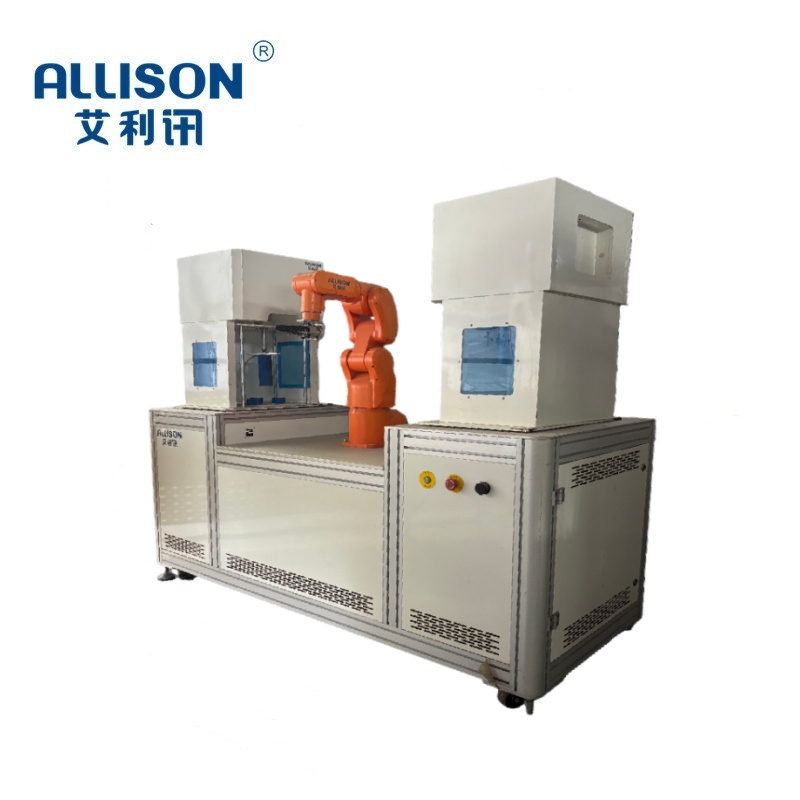
Fully automatic leak testing equipment, customized and developed according to customer requirements, is universally applicable for leak testing products. It utilizes a 6-axis robotic arm to replace manual sample retrieval and placement, coupled with a multi-station leak testing platform, to achieve fully automated retrieval, placement, and defective product screening functions for tested products. It eliminates traditional issues such as manual retrieval and placement, sample misoperations, and defective products. It enables 24-hour continuous operation. The testing platform is suitable for air tightness testing and pressure resistance testing of high-precision, high-pressure components and complete machines, with data recording capabilities and product data analysis abilities. The system is easy to operate, utilizes imported and well-known domestic brands of components, and operates stably and reliably.
Fully automatic sealing by robotic armThe core of the sealing testing equipment (airtightness/waterproof testing) lies in automated loading and unloading combined with multi-station sealing inspection. The testing content, conditions, and standards are all structured and organized as follows, ready for immediate use:
1. Core testing content (mandatory)
1. Pressure decay/differential pressure leakage test (mainstream)
- Inflation → Pressure stabilization → Pressure maintenance → Detection → Pressure relief, measure pressure drop ΔP and leakage rate
- Judgment: pressure drop ≤ threshold, leakage rate ≤ standard value (e.g. ≤ 0.05 kPa/10s)
2. Vacuum negative pressure sealing test
- Vacuumize to the set negative pressure (such as -60 to -90 kPa), measure the pressure recovery rate and vacuum holding capacity
- Used for cavity, waterproof shell, and vacuum gripper circuit testing
3. IP protection level test (waterproof and dustproof)
- According to IEC 60529 and GB 4208
- IP67: 1m water depth for 30min; IP68: deeper/longer; combined with airtightness determination
4. Pressure retaining performance/Static sealing test
- Maintain pressure for 5-60 minutes under rated pressure, with no significant pressure drop
- Verify the long-term sealing performance of seals, welds, and joints
5. Dynamic sealing test (optional)
- Synchronized airtightness under robotic arm movement/vibration, measuring leakage changes during movement
- Simulate actual working conditions (dynamic sealing of joints, pipelines, and connectors)
6. Burst pressure/pressure resistance test (optional)
- Gradually increase the pressure to failure, measure the maximum withstand pressure, and verify the safety margin
7. Temperature cycling and sealing test (optional)
- Cycle through -40~150℃, measure the change in leakage rate under high and low temperatures





 Online
 Tel
Tel Contact
 Home
Home