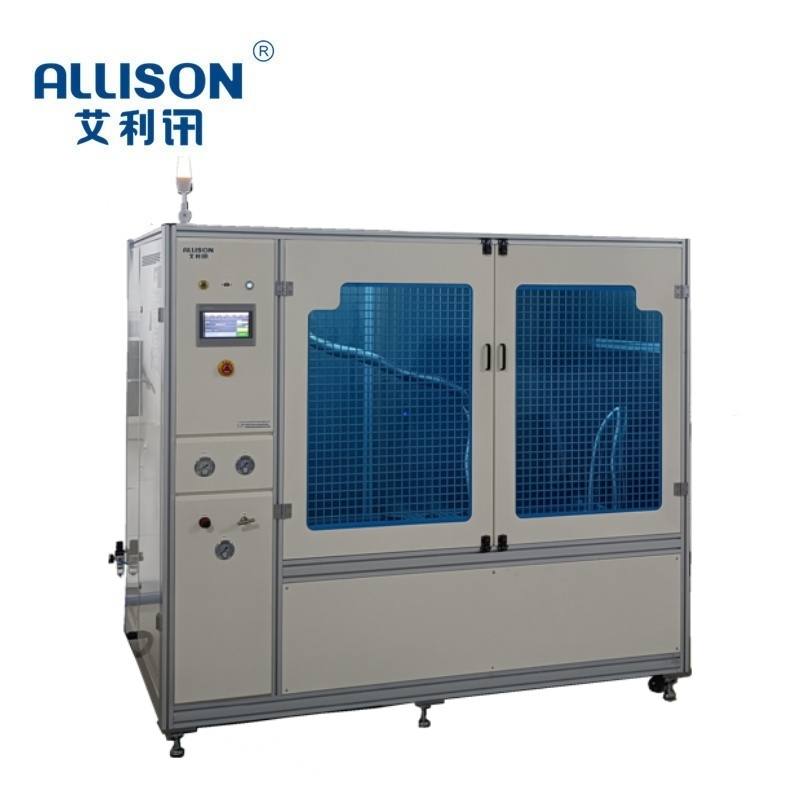
test equipment
1) Environmental conditions
-Medium: Clear water (20 ± 5 ℃), free of impurities and bubbles, with normal conductivity.
-Water temperature: 0-40 ℃, fluctuation ≤± 1 ℃.
-Environmental temperature: 5-40 ℃, humidity ≤ 85%, no condensation.
-Power supply: 380V ± 5%/220V ± 5%, 50Hz ± 1%, stable grounding.
-Installation site: Horizontal foundation, vibration reduction treatment, space suitable for pipeline disassembly and maintenance.
2) Equipment configuration conditions (mainly closed test bench)
-Pipeline system: closed cycle, pressure stabilizing tank, electric regulating valve, inlet and outlet straight pipe sections (inlet ≥ 10D, outlet ≥ 5D, D is the pipe diameter).
-Measurement accuracy (national standard B level/1 level):
-Flow rate: ± 0.5% to ± 1% FS (electromagnetic/turbine/ultrasonic flowmeter).
-Pressure/head: ± 0.2% to ± 0.5% FS (differential pressure/pressure transmitter).
-Power: ± 1% to ± 2% FS (power analyzer).
-Speed: ± 0.1% FS (photoelectric encoder).
-Control system: PLC+upper computer, automatic acquisition, valve adjustment, curve drawing, data storage and printing.
-Safety protection: Overload, overvoltage, overheating, leakage alarm, emergency shutdown.
3) Installation and calibration conditions
-Pump installation: The inlet and outlet are aligned, stress free, the seal is intact, and the direction of rotation is correct.
-Instrument calibration: once a year, with CNAS calibration certificate.
-Pipeline sealing: no leakage, pressure bearing ≥ 1.5 times the rated pressure.
Test content
1) Flow Head (Q-H) Curve (Flow Capacity Core)
-Test points: 7-11 operating conditions (0-150% rated flow, including dead center, rated point, and maximum point).
-Record: Head, inlet pressure, outlet pressure, water temperature, and speed at each flow rate.
-Determination: The head deviation under rated flow rate is ≤± 5% (GB/T 3216).
2) Flow power (Q-P) curve
-Testing: Simultaneously measure voltage, current, power factor, and input power.
-Calculation: Shaft power, hydraulic power, efficiency η=ρ gQH/P.
-Judgment: The rated operating efficiency meets the standard
3) Flow efficiency (Q - η) curve
-Draw: Full operating efficiency curve, determine the highest efficiency point and high-efficiency zone range.
4) NPSH test (to prevent cavitation and ensure stable flow)
-Method: Step by step pressure reduction method, maintain the rated flow rate, and reduce the inlet pressure until the head drops by 3%.
-Determination: NPSHr must be ≤ nominal value
5) Mechanical performance
-Vibration: ≤ 4.5mm/s (ISO 10816), no abnormal noise.
-Temperature rise: Bearing ≤ 70 ℃, motor winding ≤ 120 ℃
6) Sealing and leakage
-Mechanical seal: Leakage rate ≤ 0.1mL/min, no dripping.
-Packing seal: allows for trace dripping
7) Durability/lifespan testing
-Operating conditions: 110% rated flow, 120% rated pressure, continuous operation for 500-1000 hours.
-Assessment: Performance degradation, seal wear, bearing life





 Online
 Tel
Tel Contact
 Home
Home