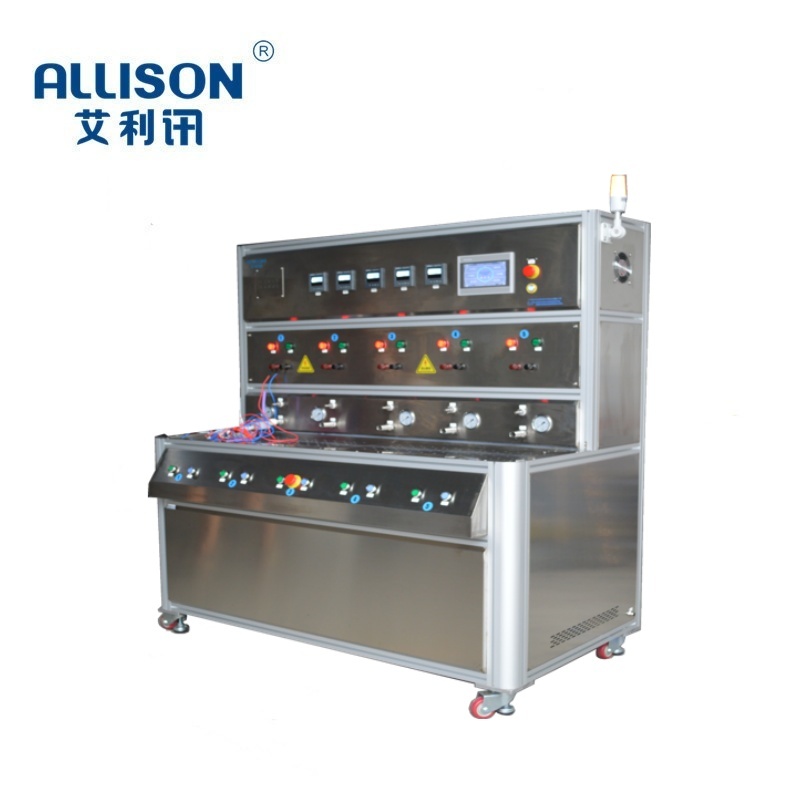
The aging testing equipment for drainage pumps consists of a main frame welded with 304 stainless steel square tubes and sealed with 304 # sheet metal. The testing platform is suitable for online comprehensive performance testing of water pumps, consisting of four independent testing stations that are not affected by each other. The device is equipped with a 10 inch display screen for setting up functions and displaying data. The device adopts a one click start detection, and the system automatically judges whether it is qualified or unqualified. Qualified - OK, Unqualified - NG. No need for dedicated personnel to operate, simplifying and facilitating the use of operators.
The testing platform mainly consists of a testing platform, a water temperature control system, electrical parameter power acquisition, temperature acquisition, flow acquisition, vibration frequency acquisition, and an electronic control system. Test platform: Made of 304 # stainless steel structure welded together, the working platform is equipped with a water receiving tray below: made of 304 stainless steel, with a slope in the center of the water receiving tray and a drainage pipe at the lowest point, which can be recovered or discharged from the box through an external drainage valve. Control the water temperature of the water tank through the customer's self equipped heat pump cooling device
Standard test conditions (based on QB/T 4273, GB/T 4288, IEC 60335-2-7)
-Environment: Temperature 25 ± 2 ℃; Humidity 45% -95% RH; atmospheric pressure.
-Medium: Clear water/detergent containing water; The temperature can be adjusted from room temperature to 90 ℃; pH 6–9。
-Electrical: rated voltage ± 10% (AC 100-240V/DC 12-48V); Frequency 50/60Hz; current accuracy ± 0.5% FS.
-Load: Head 0.1-1.0MPa; Flow rate 0.5-5L/min; Adjustable flow resistance
-Control: PLC+industrial computer; Cycle times 1-999999 times; Start stop cycle 1-9999s adjustable
Aging test content
1. Continuous operation aging
-Operating condition: rated voltage+rated load, continuous operation for 1000 hours (standard requirement).
-Monitoring: current, power, flow rate, head, pump body temperature, vibration, noise.
-Judgment: No leakage, no abnormal noise; Performance degradation ≤ 15%; Insulation resistance ≥ 2M Ω.
2. Start stop cycle aging (simulating actual use)
-Cycle: Start for 30 seconds → Stop for 30 seconds, cycle ≥ 50000 times.
-Medium: alternating hot water at room temperature/60 ℃; Contains trace amounts of detergent.
-Assessment: motor starting performance, bearing wear resistance, sealing fatigue resistance, capacitor durability.
3. High temperature/alternating cold and hot aging (environmental stress)
-High temperature aging: Hot water circulation operation at 40-90 ℃ for 200-500 hours.
-Cold and hot shock: Run 90 ℃ hot water for 30 minutes → run cold water (15 ℃) for 30 minutes, cycle ≥ 100 times.
-Assessment: Heat aging resistance of seals, thermal deformation of plastic parts, and high temperature resistance of motor insulation.
4. Voltage fluctuation aging (power grid fluctuation)
-Overvoltage: 115% -130% rated voltage, running for 200 hours.
-Undervoltage: 85% rated voltage, with 10000 start stop cycles.
-Assessment: Motor withstand voltage, insulation resistance to electrical degradation, control board stability.
5. Load alternating aging
-Variable load: 50% load → 100% load → 150% load, cyclic operation.
-Assessment: impeller fatigue, bearing wear, pump body structural strength, dynamic sealing performance.
6. Sealing and leakage aging
-Pressure holding: hold at 0.5MPa for 30 minutes, pressure drop ≤ 0.05MPa.
-Long term leakage: The leakage rate at the sealing points (shaft seals, interfaces) monitored throughout the aging process is ≤ 1 drop/10 hours.
7. Vibration/noise aging
-Vibration: Simulate transportation/operation vibration (10-1000Hz, 0.1-1mm amplitude) for 100 hours.
-Noise: monitored throughout the entire process, ≤ 65dB (A); No abnormal friction or noise.
8. Accelerated aging
-Stress superposition: high temperature (60 ℃)+overvoltage (120%)+high load (120%), accelerated to failure.





 Online
 Tel
Tel Contact
 Home
Home