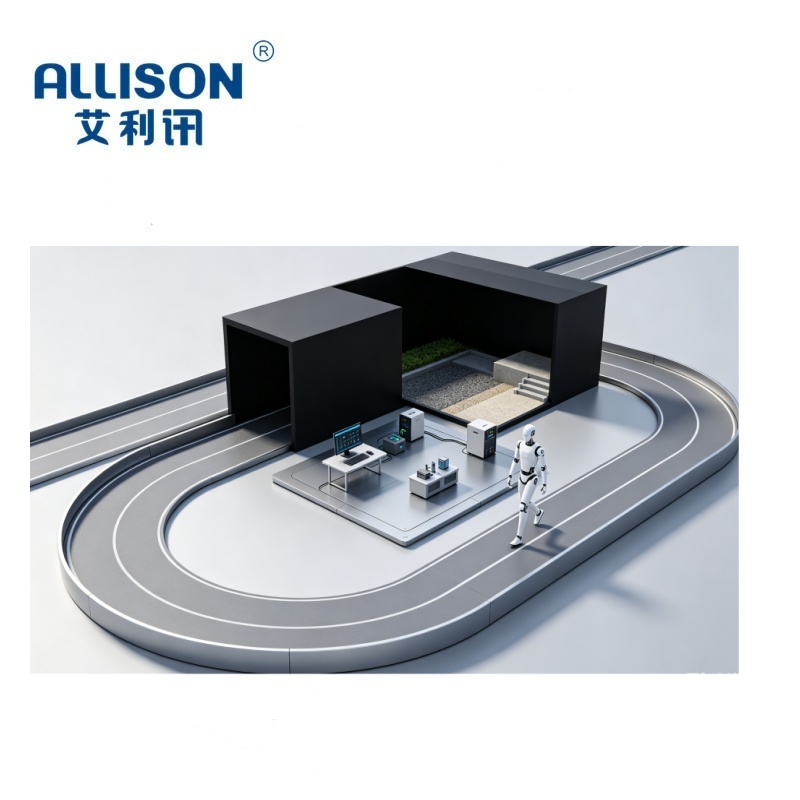
Preliminary preparation: Use specialized fixtures to fix the humanoid robot being tested, set up temperature rise and measurement points, and connect to the PLC temperature acquisition circuit; Debugging wireless temperature rise recorders, illumination control systems, and various testing equipment to ensure that data collection and equipment operation are normal; Prepare various testing surfaces, obstacles, and fixtures, and place them in place according to standard requirements.
Lighting environment temperature rise test: Turn off the lighting equipment in the testing room, calibrate the illuminance instrument, set up a 50 lux standard low light testing environment, and complete the low light steady-state test; Switch to the corresponding level of strong light environment and complete the strong light steady-state test; Complete the testing of switching between low light to strong light and strong light to low light conditions in sequence, and synchronously collect temperature rise data throughout the process.
Surface and stability testing: Conduct elevation changes and stability tests on various hard and soft surfaces, including slopes (including wet glass slopes), stairs, depressions, floor thresholds, etc., and record the robot's passage status and stability parameters.
Obstacle testing: On the designated testing surface, various obstacles (including specialized testing equipment and physical obstacles) are arranged to test the robot's ability to recognize, avoid, and pass through obstacles, and relevant performance data is recorded.
Sharp edge testing: Install sharp edge testing equipment according to standard requirements, conduct sharp edge contact testing, and record relevant safety performance data of the robot.
Data organization and judgment: The entire process relies on PLC+wireless temperature rise equipment and various testing instruments to continuously collect relevant data on robot operation temperature rise, stability, obstacle avoidance, sharp edge contact, etc. Combined with domestic and foreign reference standards, performance judgment,
safety compliance verification, and intelligent level matching verification are completed to form a complete test report.
Testing Surface Testing UL 3300 7.2.3: Conduct robot related performance and safety testing on designated testing surfaces, classified as follows, covering all indoor and outdoor scenarios:
Hard testing surfaces: including but not limited to wooden flooring, laminated boards, vinyl flooring, ceramic tiles, reflective tiles (indoor); Concrete, asphalt, crushed stone (outdoor).
Soft testing surface: including but not limited to carpets (refer to IEC 62885-2), rubber pads (indoor); Lawn, grass, soil, sand (outdoor)
Related testing content
Temperature Rise Test
Adopting a wireless terminal data acquisition system, the data acquisition end is composed of a PLC programmable controller, which reads the real-time operating temperature of the robot and its core components in real time. 36 temperature acquisition points are used to collect real-time operating temperature and standby temperature of each joint of the robot.
Test ground/stability/obstacle testing
1. Test surface: hard surface (wooden floor, laminated board, vinyl floor, ceramic tile, reflective tile, concrete, asphalt, gravel), soft surface (carpet, rubber mat, lawn, grass, soil, sand)
2. Obstacle testing equipment: Adult torso (diameter 200mm x length 600mm cylinder, made of black felt/coarse cloth, reflectivity 5% -10%), adult calf (diameter 70mm x height 400mm cylinder, made of black felt/coarse cloth, reflectivity 5% -10%), toddler dummy (14.5kg, standing/sitting, made of black felt/coarse cloth, reflectivity 5% -10%), infant dummy (9.4kg, crawling/lying posture),
Made of black felt/coarse cloth, with a reflectivity of 5% -10%), wall panels (pine wood, colorless acrylic panels with a light transmittance of>95%, height of 1.5m x width of 1m), table (wooden/steel legs, height of 0.7-0.8m, width of 1.5-2.0m, depth of 0.5-0.8m, leg thickness of 0.03-0.05m, minimum weight of 16.6kg), 15mm high metal floor threshold, 1 backpack, sports equipment such as baseball bat, ball, skateboard, and scooter, each 1 piece
1 food and beverage container each, glass jar and glass bottle (1 transparent, 1 green, 1 brown); Pets and livestock; (Provided by the customer), 1 piece of adhesive tape, 1 piece of cardboard, moving objects (provided by the customer), automatic vacuum cleaner (indoor); (Provided by the customer), automatic lawn mower (outdoor); (Provided by the customer) Other robots (provided by the customer), movable obstacles, objects that can reflect or refract light;
Pipeline/nozzle; Wheelchairs, canes, crutches, fences (railings, chains, etc.); And the power cable (such as SJT cable No. 14 or equivalent flexible cable) connected from the portable power faucet, sports equipment: 1 bat, 1 blue ball, and 1 skateboard.
3. Sharp edge testing equipment: using steel mandrel (diameter 9.53mm ± 0.12mm, surface roughness ≤ 0.40 microns, Rockwell hardness C grade ≥ 40, no scratches or burrs, length adaptation testing), pressure-sensitive polytetrafluoroethylene high-temperature electrical insulation tape (substrate thickness 0.066-0.089mm, nominal thickness of silicone adhesive 0.08mm, width ≥ 6mm, testing temperature 21.1-26.6 ℃)
4. Slope testing: Slope testing platform (suitable for indoor/outdoor robot slope), programmable angle adjustable. The testing platform adopts wet glass ramps, stairs (in compliance with specifications), depressions (of different width specifications), and various physical obstacles (backpacks, baseball bats, glass jars, etc.)
Lighting environment temperature rise test (UL 3300 7.2.9) a) Low intensity standard lighting environment: A darkroom test room is constantly created with a low light condition of 50 lux, and temperature data is synchronously collected.
b) High intensity graded lighting environment: Indoor specialized humanoid robot, constant 10000 lux strong light environment; Universal humanoid robot for all scenarios, with a constant 100000 lux strong light environment, synchronously collecting temperature data.
c) Light gradient condition one: smoothly transition from a 50 lux low light environment to a corresponding level of high-intensity light environment, and synchronously collect temperature data throughout the process.
d) Light gradient condition two: smoothly transition from the corresponding high-intensity lighting environment to a 50 lux low light environment, and continuously record the temperature rise curve.
Robot Stability Test (UL 3300 7.2.4)
1. Environmental Change Test (UL 3300 7.2.4.1)
Staircase environment: riser height ranging from 15.24 cm to 19.05 cm; The width of the staircase between vertical obstacles should be at least 55.88 centimeters; The tread depth should be at least 30.48 centimeters ± 5.08 centimeters.
Smaller depression environment: The width of the depression is 50% of the robot width, 100% of the robot width, 1 meter, and 2 meters, respectively, to test the stability of the robot's passage in the depression environment.
Floor threshold environment: ① Crossing a metal floor threshold 15 millimeters high on a hard test surface; ② Transition from a hard test surface to a soft test surface on a 15mm high metal floor threshold; ③ Transition from soft test surface to hard test surface on a 15mm high metal floor threshold.
2. Slope testing (UL 3300 7.2.4)
Downward slope: Tilt 5 ° (indoor robot) or 15 ° (outdoor robot) downwards from the horizontal plane, while testing the turning stability of the robot from 90 ° to 180
Upward slope: Transition from the horizontal plane to a slope of 5 ° (indoor robot) or 15 ° (outdoor robot), while testing the robot's turning stability from 90 ° to 180
Obstacle Test (UL 3300 7.2.5, 8.4.5)
1. Types of obstacles
Fixed/static obstacles: backpacks, baseball bats, balls, skateboards/scooters, glass jars (different colors such as transparent, green, brown, etc.), glass bottles, pets and livestock, attention tape, cardboard, pipes/nozzles, wheelchairs, canes, crutches, walkers, fences (railings, chains, etc.), power cables from movable power taps (such as SJT cable No. 14 or equivalent soft cables).
Mobile objects/obstacles: Automatic vacuum cleaners (indoor), automatic lawn mowers (outdoor), other robots, objects that can reflect or refract light.
2. Specification of obstacle testing equipment
Specification of obstacle testing equipment
Adult torso: a cylindrical body with a diameter of 200mm and a length of 600mm, made of black felt or coarse cloth, with a reflectivity controlled between 5% -10%.
Adult calf: a cylindrical shape with a diameter of 70 millimeters and a height of 400 millimeters, made of black felt or coarse cloth, with a reflectivity controlled between 5% -10%.
Child body: ① Child dummy (14.5 kg), with mass distribution referring to Table 2 and dimensions referring to Figure 1, placed in standing and sitting positions; ② Baby dummy (9.4 kg), with mass distribution as shown in Table 3 and dimensions as shown in Figure 2, placed in crawling and lying positions; Both are made of black felt or coarse cloth, with a reflectivity controlled between 5% -10%.
Wall: A board similar to a wall, including pine wood and colorless acrylic board with a light transmittance of over 95%, with a specification of 1.5 meters high and 1 meter wide.
Table: A disc-shaped structure with four legs (wooden legs like pine wood, metal legs like steel), height 0.7-0.8 meters, wi
2.dth 1.5-2.0 meters, depth 0.5-0.8 meters, leg thickness 0.03-0.05 meters, minimum weight 16.6 kilograms.





 Online
 Tel
Tel Contact
 Home
Home