1. Control of swing angle and swing frequency of the swing tube
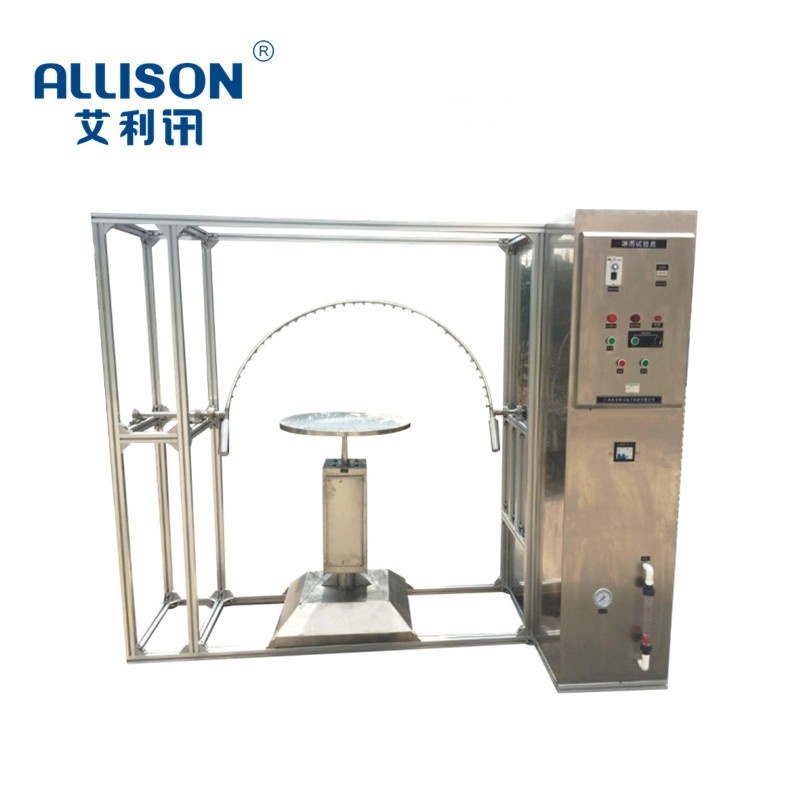
Set the left and right swing angles, reciprocating swing frequency/swing rate of the semi-circular swing tube, and simulate splashing and spraying water in different directions.
2. Water spray pressure and flow regulation
Control the nozzle outlet pressure and water flow rate, set according to the corresponding protection level standards, to ensure stable spray intensity.
3. Water quality requirements
Generally, clean tap water is used, and some standards require control of water temperature and impurity content to avoid nozzle blockage.
4. Test duration setting
Set the continuous spraying time according to product specifications or national standards, which can be divided into two modes: continuous spraying and intermittent spraying.
2、 Sample posture and installation testing requirements
1. Multi pose testing of samples
In addition to rotating around its own centerline, directional spraying will also be carried out on different installation surfaces and key sealing positions (seams, interfaces, wire harness holes, shell gaps) of the sample.
2. Stability verification of fixed methods
During the process of rotating and swinging the spray tube on the sample, ensure that the installation fixture is not loose or displaced, and guarantee the accuracy of the testing position.
3、 Dust prevention/sand immersion related supporting testing content
1. Control of dust concentration and airflow velocity
If the device integrates sand and dust functions, it is necessary to set the sand and dust spray concentration, airflow speed, and simulate dust and sand immersion environments.
2. Sand and dust deposition and adhesion inspection
After the experiment, check whether there is sand or dust accumulation inside the sample chamber and sealing area.
4、 Performance verification after testing (key judgment items)
1. Appearance inspection
Check for water seepage, sand ingress, condensation, and rust at the shell, sealing surface, and joints.
2. Electrical performance testing
Power on and check whether the car lights, door locks, instruments, and electrical components are short circuited, leaking electricity, or have abnormal functions.
3. Sealing integrity test
Disassemble or verify whether the internal cavity remains fully sealed through airtightness testing.
5、 Corresponding to commonly used standards
This type of equipment is usually based on:
GB/T 4208 "Degrees of Protection Provided by Enclosures (IP Code)"
ISO 16232, SAE J2033 Automotive Parts Waterproof and Dustproof Related Specifications





 Online
 Tel
Tel Contact
 Home
Home