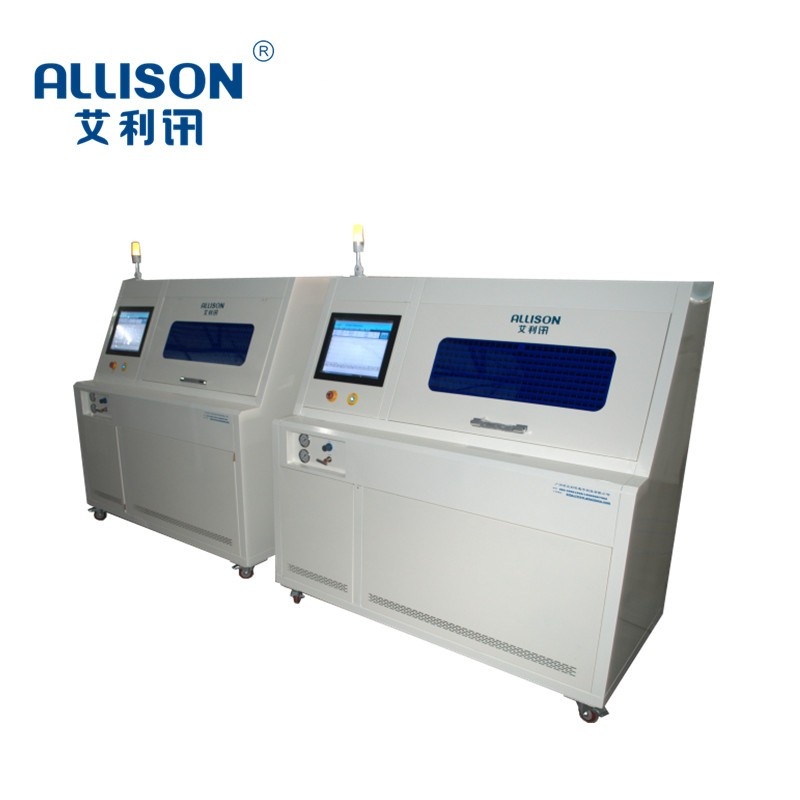
The high-pressure piston sleeve pressure sealing testing equipment is customized according to customer requirements and relevant testing standards. The equipment meets the requirement of conducting pressure sealing testing on the piston sleeve under specified high pressure, and determines whether it is qualified or unqualified through pressure upper and lower limits/pressure drop. The brake fluid is used as the test fluid, and the high-pressure variable frequency pump is used for constant pressure pressurization. High precision sensors are used for pressure control and pressure leakage judgment. By collecting simulated signals from pressure sensors at high speed, the system automatically generates a pressure curve and judges the sealing performance based on the peak/valley values of pressure changes. Qualified - display green light, unqualified - display red light, and sound and light alarm prompt.
By using variable frequency high-pressure pump constant pressure technology, the tested product is subjected to a pressure holding test at a constant pressure that can be set between 5-25Mpa. 17 inch touch sensitive industrial control computer display and control, through self-developed programs, controlled by PLC for pressure holding, constant pressure, holding time, leakage judgment and other program control. Through experimental data judgment, the tested products are comprehensively evaluated for their operating conditions. The testing machine is mainly used to check whether the product meets the relevant design requirements. Automatically generate waveform curves for relevant test data, including sine, trapezoid, and static. The relevant test data can be exported and printed via USB. The relevant test data can be generated by oneself and the test report can be printed through a printer.
The box body is made of 304 stainless steel for the inner box and A3 powder coating process for the outer box. Adopting ergonomic design, with a flip up door opening. There are LED lights and automatic door shutdown functions inside. The experimental door adopts a mesh explosion-proof door design, and the working platform is a 304 non inductive steel plate. It can effectively prevent rust and carry out testing water recovery. The equipment operation adopts a self-developed system, which is easy to operate and does not require a dedicated person to operate.





 Online
 Tel
Tel Contact
 Home
Home