Core testing projects
1. Gas phase filtration efficiency (comparison of upstream and downstream concentrations)
2. Filter resistance/pressure difference (air volume resistance curve)
3. Dynamic adsorption capacity and breakthrough curve
4. Saturation adsorption duration and desorption performance
5. Synchronized control of air volume, temperature and humidity, and monitoring of background particulate matter
System Composition
1. Clean air supply system: multi-stage pre purification, ensuring that the cleanliness of particulate matter in the air duct is better than ISO level 5, eliminating particle interference, and only measuring gas-phase molecular adsorption
2. Pollutant generation and gas distribution module: VOC/acidic gas/alkaline gas generation, mass flow gas distribution, concentration adjustment range of 0.1-90 ppm; Support multiple target gases such as toluene, formaldehyde, SO ₂, NO ₂, NH ∝, etc
3. Constant temperature and humidity section: Control the temperature and humidity of the air duct, simulate actual working conditions (temperature and humidity will significantly affect the adsorption performance of activated carbon and molecular sieve)
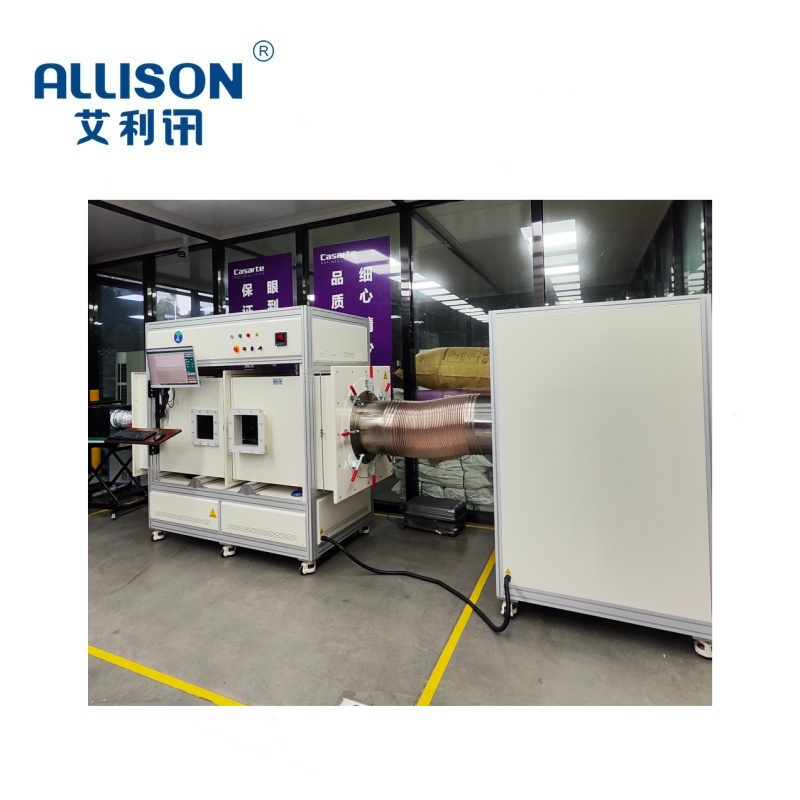
4. Test sample section: Standard testing fixture, compatible with 610 × 610, W-type, plate type, and cylindrical chemical filters
5. Gas analysis sampling system: upstream and downstream synchronous sampling, high-precision gas analyzer
6. Differential pressure acquisition unit: Differential pressure transmitter, range 0-2000Pa, high-precision acquisition of resistance
7. Industrial control+software: automatic gas distribution, stable voltage regulation, data acquisition, drawing penetration curves, report export
Key technical parameters (matching with images)
Air duct background cleanliness: better than ISO level 5
Pollutant concentration: 0.1-90 ppm
Airflow range: 50-1100 m ³/h, wind speed 0.1-0.8 m/s
Resistance test range: 0-2000 Pa
Temperature control: 15-40 ℃, humidity: 20-90% RH adjustable
Gas path material: Low adsorption pipeline (PTFE/316L), reducing testing errors caused by wall adsorption
Test Procedure
Clean air pretreatment → Set air volume, temperature and humidity → Turn on pollutant generator, stabilize air supply → Collect initial concentration upstream → Continuously pass gas through the chemical filter to be tested → Monitor outlet concentration in real-time downstream → Record pressure difference and concentration changes over time, generate penetration curve → Calculate initial efficiency and saturation capacity.
Features of the equipment
Particle background is extremely low, ISO5 level air duct, distinguishing between particle filtration and gas-phase molecular adsorption
Wide concentration gas distribution range, low concentration 0.1ppm simulated environmental background, high concentration 90ppm accelerated aging capacity testing
Low adsorption gas path design reduces pipeline adsorption loss and ensures test repeatability
Can be used for research and development, type inspection, incoming material sampling, and life penetration testing
Optional configuration
Multi channel switching sampling and simultaneous comparison of multiple filter samples
Increase temperature and humidity to accelerate aging chamber front
Vehicle filter dedicated module (ISO11155 automotive cabin chemical filter standard)
MES docking, scanning sample traceability





 Online
 Tel
 Contact
 Home